
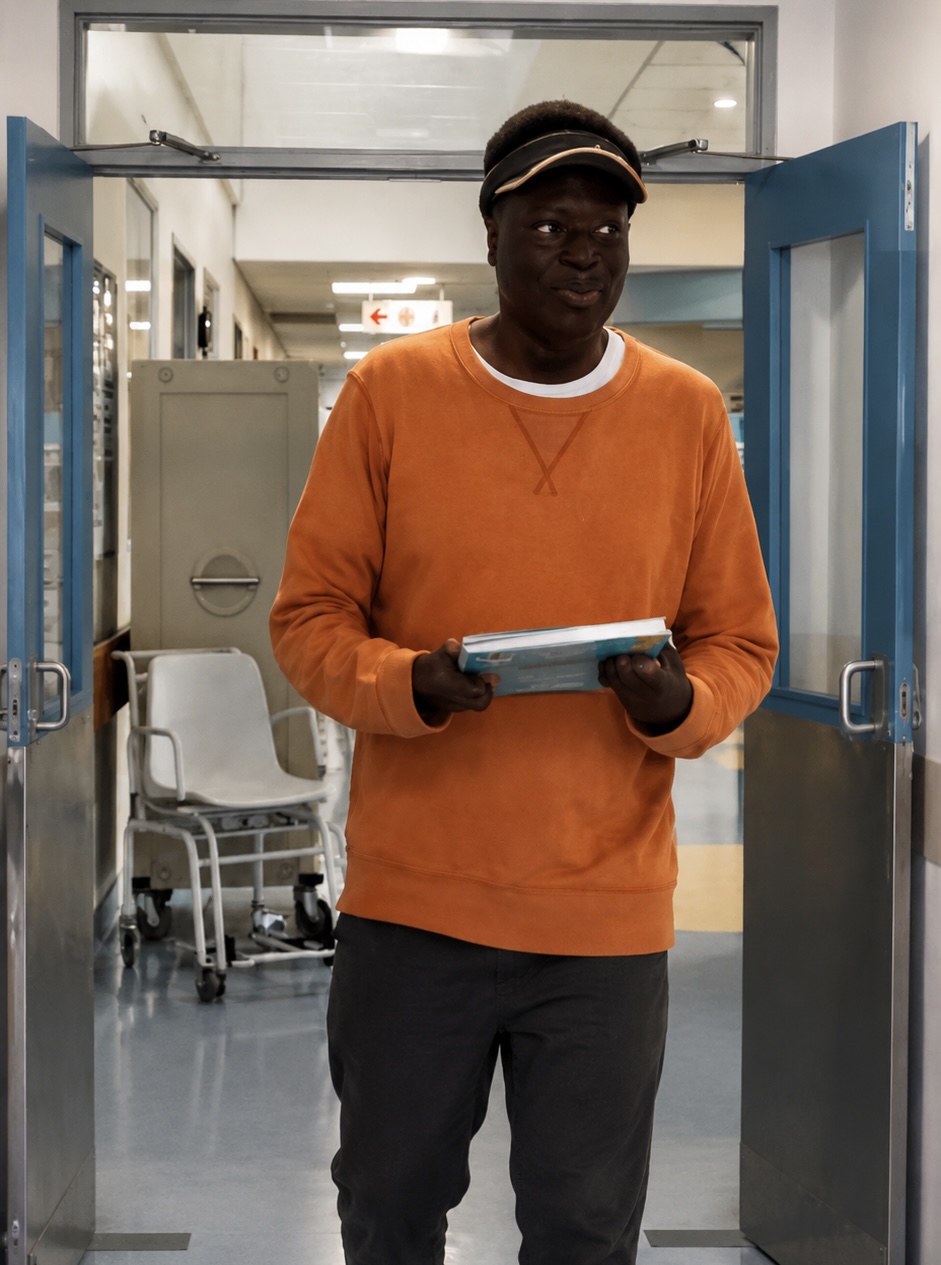
The first thing you notice about William Baartman is his laugh. It arrives before the sentence does, warm and unhurried, filling whatever room he happens to be in. He talks with his hands, or rather with what remains of them, and somehow that becomes just another part of his expressiveness, another part of who he is. He does not dwell on what is absent. He is too busy talking about what is present.
He has climbed Mount Kilimanjaro. He will tell you this with a grin that suggests he is still slightly delighted by the fact himself. He volunteers at Red Cross War Memorial Children’s Hospital, where he has been a familiar and beloved presence for decades. By his own account, it has been a full life. A good life. A life he greets each morning with genuine and abundant gratitude.
“I’ve lived. I’ve really lived.”
— William Baartman
He was four years old in 1977 when South Africa was deep in the apartheid years. A country divided not only between black and white but within communities themselves, where the politics of survival and suspicion ran through every street, every school, every household. William’s father was a teacher who taught Afrikaans, the language most closely associated with the architects of apartheid, and to some in the community, that was an unforgivable choice. The tension it created came home in the most devastating way imaginable.
William was set alight.
The burns were catastrophic covering his entire body and sadly he lost his fingers too. He was brought to Red Cross War Memorial Children’s Hospital, which had been the only dedicated burns service for children in the Western Cape since it opened in 1956. The teams here had spent two decades building expertise in injuries that most hospitals would never see: children burned by fires, by paraffin lamps, by gas stoves, by the particular dangers of life in communities where warmth and light came with real risk attached. Burns of this severity do not simply heal. As the skin repairs itself, scar tissue contracts, pulling at whatever lies beneath, threatening the future function of a child’s hands and body. The work of saving William’s hands, and then his future use of them, was painstaking and long.
Today, Red Cross War Memorial Children’s Hospital admits up to a thousand children a year as burns inpatients, and between four and five thousand more as outpatients. It remains the only facility of its kind for children in the Western Cape. The clinical knowledge built across those decades now being carried outward through a Children’s Hospital Trust-funded programme to hospitals in Ceres and Worcester, so that children across the Cape Winelands no longer have to travel hours through multiple facilities before reaching specialist care. This expansion strategy traces a direct line back to the children treated in the hospital’s earliest years. Children like William.
But inside those wards in 1977, what he remembers is something quieter than clinical skill.
“In Red Cross Hospital, there was no boundaries. There was no black or white. The nurses and doctors, they worked together.”
— William Baartman
For a boy whose body had been burned because of the divisions tearing his world apart, that was not a small thing. He had arrived as a victim of hatred. He was treated as a child who needed care.
The difference between those two things shaped the rest of his life.
None of it came without support from beyond the hospital’s walls. For three decades, the Children’s Hospital Trust has raised the funds that enable the hospital to build, expand and sustain services like the Burns Unit; the equipment, the infrastructure, the outreach programme now reaching deep into the Western Cape. The community that built this hospital across seventy years, donor by donor and year by year, made William’s recovery possible. It is a generosity that has taken many forms, from many hands, over many generations.
William came back. Not as a patient this time, but as a volunteer. He sits with the families who arrive frightened and exhausted at all hours of the day and night. He talks to them. He makes them laugh if he can.
“Even when they go, I always feel like I have made the change. I have made a connection with someone. I gave someone hope.”
— William Baartman
He has been doing this for decades, this man who arrived here at four years old and never really left. Who climbed a mountain. Who fills every room with his laugh. Who will tell you, without hesitation, that he has lived a full life.
