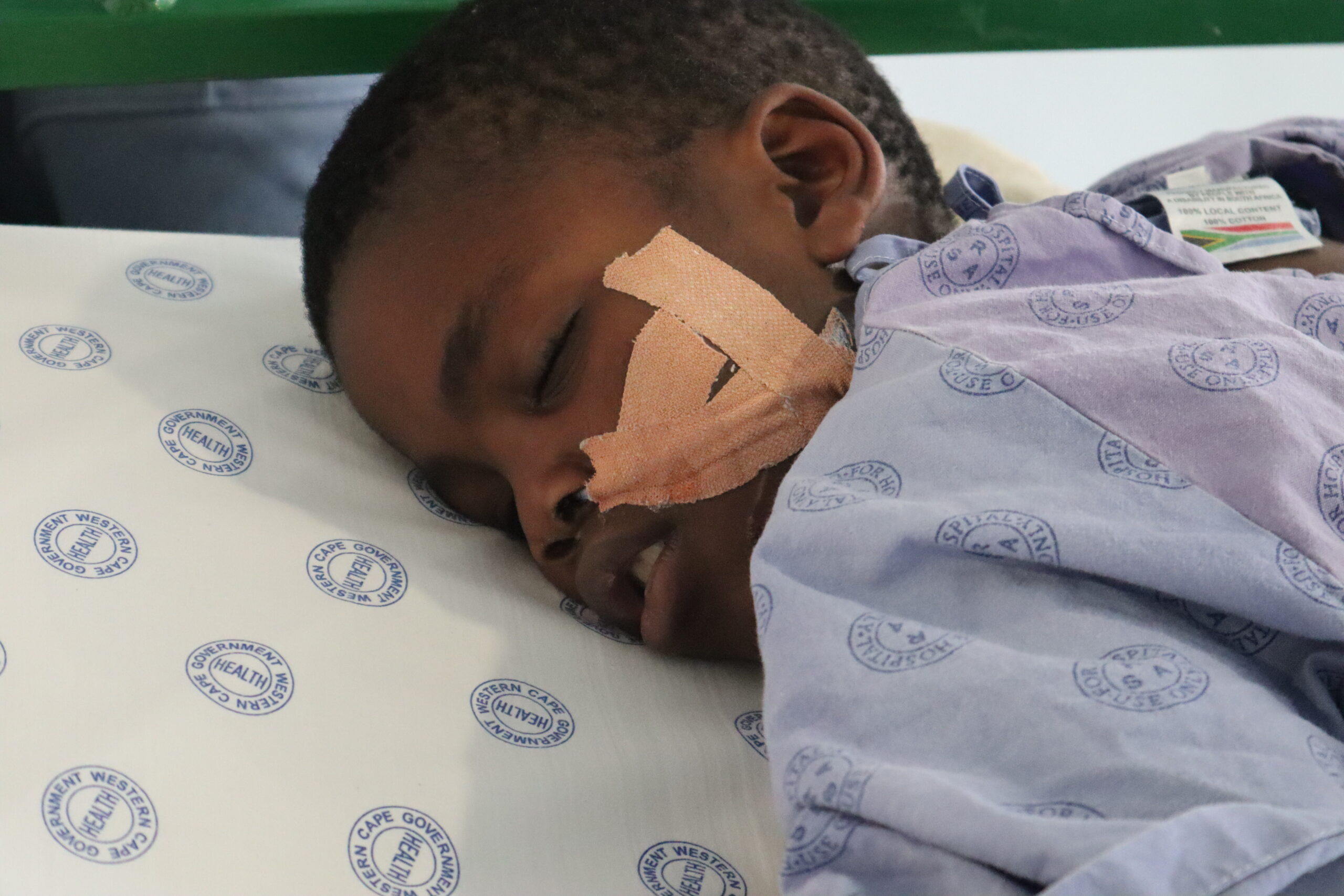
His father says he hasn’t decided yet. Some days David wants to be a doctor. Other days, a pilot. At six years old, he keeps his options open.
David was born in Cape Town in February 2020. As a young child, he walked and played like his peers. He is also very good at his schoolwork, his father says proudly. There was little to suggest that anything was seriously wrong. But one day, David was not feeling well and told his grandmother he didn’t want to go to school. He was sent to school anyway where he slept most of the day. His teacher sent him home.
Like most kids his age, when school was out and his friends were home, David was outside playing in the streets as he would every other day. Only this time, when David fell, he could not get back up again. Life, as David knew it would be very different from this day on. David has undiagnosed Cerebral palsy.
Cerebral palsy is caused by damage to the developing brain, typically before, during, or shortly after birth. In David’s case, the form he has, spastic diplegia, primarily affects the legs, locking the muscles in a state of constant tightness. The condition does not always announce itself immediately and many children, particularly those in communities without easy access to specialist care, it reveals itself gradually as the spasticity increases and the body’s demand for movement outpaces what the legs can manage.
David’s parents are hardworking. His father, a truck driver, made the difficult decision to send David to live with his grandmother while he and David’s mother, who works long hours as a domestic worker, tried to build a more stable life. When the “accident” happened, as his family refers to the incident where David’s life changed forever, local medical facilities could not identify what was wrong or offer any treatment. By the time word reached his father, David could no longer walk at all. His grandmother was carrying him to the toilet, to meals, to bed.
His father had lost his truck driving job by then. He was working as a petrol attendant, saving what he could. When he understood how serious things had become, he scraped together R4,500, the cost of bringing David back to Cape Town.
“I just said, let me pray to God and bring my child to where I am, so I can find out what is really wrong.”
In Cape Town, a local clinic examined David but could not determine the cause of his condition. They referred the family to the Red Cross War Memorial Children’s Hospital.
There, Associate Professor Nico Enslin examined David and diagnosed spastic diplegia. To confirm that surgery could help, he injected Botox into the affected muscles, a temporary measure that reduces spasticity. When the tightness in David’s legs released even partially, the effect was immediate. He stood up. He took steps across the room with a walking frame.
A/Prof. Enslin then performed a selective dorsal rhizotomy: a procedure pioneered at RCWMCH in 1979 by Professor Warwick Peacock and still offered nowhere else in sub-Saharan Africa. The operation selectively reduces the nerve signals causing the spasticity, giving David’s muscles a chance to work as they should. The surgery requires a neurosurgical operating microscope. Without one, it cannot be performed.
David is now recovering. It will take months of rehabilitation to build the strength his legs have never had the chance to develop. But the spasticity that locked him in place is gone. For the first time, the road ahead exists.